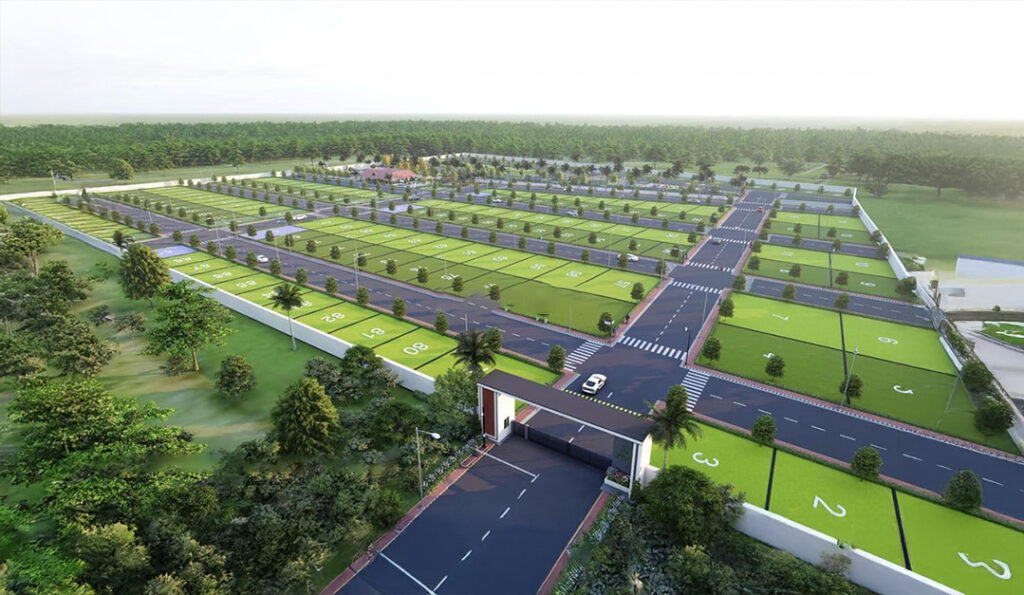
Dreaming of building your own home or an investment property in the bustling city of Hyderabad? A 300 sq yds plot is often a popular choice for many homebuyers and investors. But a crucial question that comes to mind is: “How many floors can I actually build on this plot?” The answer isn’t as simple as you might think. It depends on several important factors, all governed by the rules of the Greater Hyderabad Municipal Corporation (GHMC).
This long-form article is your ultimate guide, breaking down everything you need to know about GHMC building permissions and the rules for constructing on a 300 sq yds plot in Hyderabad. We’ll cover key concepts like FSI, setback rules, and the permissions required, all in simple, easy-to-understand language. By the end of this guide, you’ll have a clear roadmap for your construction project in Hyderabad.

Understanding the GHMC Rules and Regulations
The Greater Hyderabad Municipal Corporation (GHMC) is the governing body that sets the rules for all construction activities within its jurisdiction. These rules are in place to ensure safe, planned, and sustainable urban development. For a 300 sq yds plot, these regulations are particularly important as they determine the maximum number of floors, the total built-up area, and the open spaces you must maintain. Ignoring these rules can lead to serious legal issues, including demolition notices.
A 300 sq yds plot is roughly equivalent to 250 square meters. According to the latest GHMC building bye-laws, this size of plot is a key benchmark for certain types of residential construction.
The Golden Number: How Many Floors Are Allowed?
So, let’s get to the main point. For a 300 sq yds plot in Hyderabad, you are generally permitted to construct a building with a Stilt + Four Floors (G+4) or a Stilt + Three Floors (G+3). This is a significant advantage over smaller plots, which may be restricted to a G+2 (Ground + Two floors) structure.
Why is this the standard?
The ability to build up to four or five floors (including the stilt floor for parking) on a 300 sq yds plot is based on specific criteria set by the GHMC. The primary factors that influence this are:
- Plot Size: A 300 sq yds plot (or a minimum of 250 square meters) is the minimum size required to get permission for a building with more than three floors.
- Road Width: The road in front of your plot plays a crucial role. A wider road allows for a taller building. Generally, a road width of 30 to 40 feet is ideal for a G+3 or G+4 building.
- Setback Rules: These are the mandatory open spaces you must leave around the building. We’ll discuss this in detail below.
- Parking & Amenities: Adequate parking space (usually on a stilt or in the basement) is mandatory for G+3 and G+4 constructions.
Deciphering the Key Concepts for Your Construction
To fully grasp the rules for your 300 sq yds plot, you need to understand two main technical terms: Floor Space Index (FSI) and Setback Rules. Don’t worry, we’ll explain them in the simplest way possible.
1. What is Floor Space Index (FSI) or Floor Area Ratio (FAR)?
FSI is a ratio that tells you the maximum total floor area you can build on a plot of land. Think of it as a multiplier.
FSI = Total Covered Area of All Floors / Total Plot Area
For example, if the FSI for your area is 1.5, and you have a 300 sq yds plot, the total built-up area you are allowed to construct is:
300 sq yds * 1.5 = 450 sq yds
This 450 sq yds is the total area that can be distributed across all your floors. So, if you plan to build a G+3 structure, each floor could have a maximum covered area of around 112.5 sq yds (450 / 4). This doesn’t include the stilt floor, which is typically for parking and not counted in the FSI calculation.
It’s important to note that Hyderabad has a unique “no-FSI-cap” policy for certain developments, which allows for higher FSI values based on factors like road width and location. This means a 300 sq yds plot can often accommodate a larger total built-up area than in other cities, allowing for more spacious floors. This is why a 300 sq yds plot is considered an excellent investment.
2. Setback Rules: Why Open Space is a Must
Setbacks are the mandatory open spaces you must leave between your building and the plot boundary on all four sides. The purpose of setbacks is to ensure proper ventilation, natural light, and safety. For a 300 sq yds plot in Hyderabad, the setback rules are specific:
- Front Setback: The open space between your building and the road. This can vary based on the road width, but is typically around 10 feet for a plot with a 30-40 ft road.
- Rear Setback: The open space at the back of your building, usually around 10 feet.
- Side Setbacks: The open spaces on the left and right sides, often a minimum of 5 feet each.
These setbacks reduce the actual area on which you can construct on each floor. For a 300 sq yds plot (which is roughly 50 feet by 54 feet), after leaving these setbacks, the usable built-up area on each floor might be around 25-30 feet by 35-40 feet. This is why it’s crucial to consult a professional architect to get a precise building plan that follows all these rules.
The Building Permission Process for a 300 Sq Yds Plot
Getting building permission from the GHMC is a non-negotiable step. The process has been streamlined to a large extent with online platforms like TS-bPASS, making it easier for property owners to get approvals. Here’s a simplified breakdown of the process:
- Prepare the Documents: You’ll need key documents, including the land ownership papers, an Encumbrance Certificate (EC), property tax receipts, and a detailed building plan prepared by a licensed architect or engineer.
- Submit the Application: You can submit your application online through the TS-bPASS portal or offline at the GHMC office.
- Site Inspection: GHMC officials may conduct a site inspection to verify the plot details and the proposed plan.
- Approval and Fee Payment: Once your plan is approved and all rules are met, you will be issued a provisional approval letter along with the fee details. You need to pay these fees to get the final permission.
- Start Construction: After receiving the official GHMC building approval, you can begin your construction. It’s vital to strictly follow the approved plan to avoid penalties.
The Financial Side: Cost of Construction
While the number of floors is a key part of the planning, the cost of construction is equally important. The construction cost in Hyderabad can vary based on factors like:
- Quality of Materials: The cost per square foot can range from ₹1,500 for basic construction to over ₹3,000 for premium materials.
- Labor Costs: These vary depending on the skill and experience of the labor force.
- Location: Prime areas like Banjara Hills or Jubilee Hills have a much higher construction cost compared to the suburbs.
- Architectural Design: A complex or unique design might increase the overall cost.
For a 300 sq yds plot, you can expect to build a total of around 4,000-5,000 sq ft of built-up area (including the stilt). At an average cost of ₹2,000 per sq ft, the total construction cost could be around ₹80 lakh to ₹1 crore. This is a rough estimate, and it’s essential to get a detailed quote from a professional builder or architect.
The Final Takeaway: A Smart Investment
Building on a 300 sq yds plot in Hyderabad offers a fantastic opportunity for both residential and commercial development. With the right planning and adherence to GHMC rules, you can successfully construct a multi-story building that maximizes your investment. The ability to build up to a G+3 or G+4 structure allows you to create a spacious home for your family or a profitable rental property.
Whether you are looking to build a dream home or invest in a lucrative real estate project, understanding these guidelines is the first step. By following this guide, you can confidently navigate the complexities of building a home in one of India’s fastest-growing cities.
FAQs on Constructing on a 300 Sq Yds Plot in Hyderabad
1. What is the minimum plot size required to build a G+3 apartment in Hyderabad?
The minimum plot size required for a G+3 (Ground + 3 floors) apartment is 300 sq yds (250 sq. meters), according to GHMC rules.
2. Is it mandatory to have a stilt floor for parking on a 300 sq yds plot?
Yes, for constructions taller than G+2, it’s mandatory to provide a stilt floor or a basement for parking to ensure sufficient space for vehicles.
3. What is the FSI for a 300 sq yds plot in Hyderabad?
The FSI varies, but for a standard residential plot of this size, it’s typically around 1.5. However, due to the “no-FSI-cap” policy and other factors, the permissible built-up area can be higher.
4. What are the key documents needed for building permission?
You will need your land ownership documents (sale deed), Encumbrance Certificate (EC), property tax receipts, a site plan, and a detailed building plan from a licensed architect.
5. Can I get permission for commercial construction on a 300 sq yds plot?
Yes, you can, but the rules and setbacks for commercial buildings are different and may be more stringent. It is essential to check the zoning regulations for your specific plot.
6. What happens if I build more floors than permitted?
Unauthorized construction can lead to serious legal consequences, including heavy fines, demolition orders, and a stay on your project.
7. How long does it take to get GHMC building permission?
The approval process has been simplified with the TS-bPASS system. If all documents are in order, permission for smaller plots can be instant, but for a 300 sq yds plot, it can take a few weeks to a few months.
8. What is the average construction cost per square foot in Hyderabad?
The average construction cost in Hyderabad ranges from ₹1,500 to ₹3,000+ per sq ft, depending on the quality of materials and location.
9. Do I need to hire an architect for the building plan?
Yes, it is highly recommended to hire a licensed architect or a professional builder to design your building plan as they are well-versed with the latest GHMC building bye-laws and can ensure your plan gets approved without hassle.
10. Where can I find a good 300 sq yds plot in Hyderabad?
Finding the right plot is the first and most crucial step. You can find verified, legally clear plots on trusted platforms like plotsforsalehyd.in, which specialize in properties in and around Hyderabad.
Ready to Find Your Ideal Plot in Hyderabad?
Finding the perfect plot is the most critical step on your journey to building your dream home. At plotsforsalehyd.in, we understand your needs and have curated a wide range of legally verified plots across all the prime locations in Hyderabad. Our extensive listings of plots in Hyderabad offer excellent investment opportunities, and we ensure every property is a secure and valuable asset.
Don’t let the complexities of land acquisition stop you from achieving your goals. Explore our collection of prime residential plots, and let us help you find a plot that’s perfect for your plans. For personalized guidance and to find the best plots that meet all the GHMC rules, contact Karna Raju at plotsforsalehyd.in today. We are here to make your journey from a plot to a perfect home seamless and stress-free. Your dream home awaits!