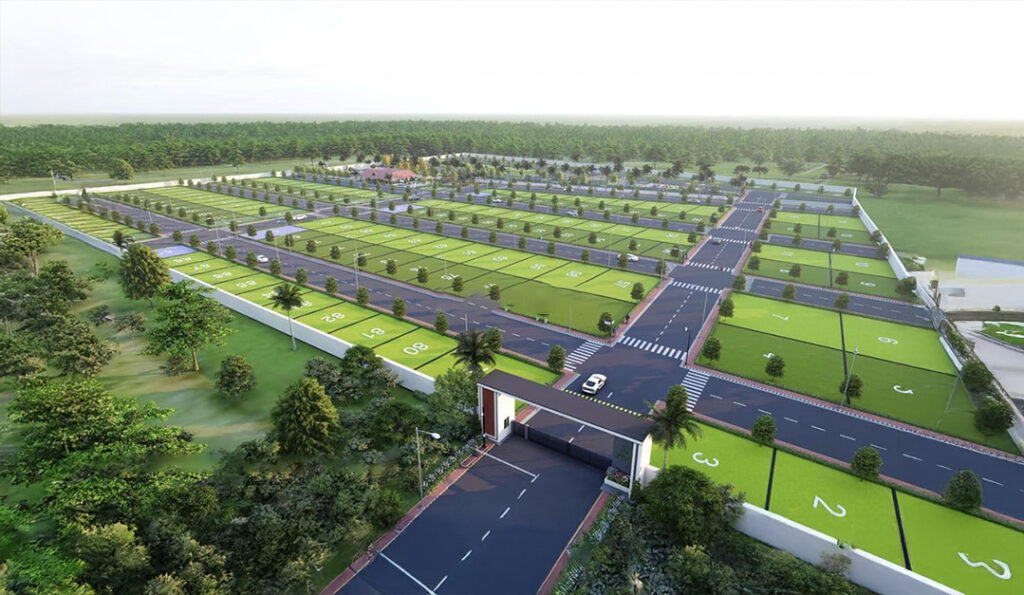
Dreaming of building your own home in the bustling city of Hyderabad? A 200 sq yds plot is a popular choice for many, offering a great balance between space and affordability. But before you start drawing up blueprints, a crucial question arises: how many floors can be constructed on a 200 sq yds plot in Hyderabad?
The answer isn’t a simple number. It depends on various factors governed by the Greater Hyderabad Municipal Corporation (GHMC) and the Telangana State Building Permission Approval and Self-Certification System (TS-bPASS) guidelines. This detailed guide will break down the rules in simple, easy-to-understand language so you can plan your dream home with confidence.
We’ll cover everything from the basic regulations to the key factors that influence your construction plan, making this your go-to resource for building a house in Hyderabad.

Understanding the Key Regulations: It’s All About the Rules 📜
When it comes to construction in Hyderabad, two main concepts determine how many floors you can build: Floor Area Ratio (FAR) and building setbacks. These rules are in place to ensure proper planning, safety, and a good quality of life for everyone.
What is Floor Area Ratio (FAR)?
Think of Floor Area Ratio (FAR), also known as Floor Space Index (FSI), as your construction budget. It’s a ratio that tells you the total built-up area you’re allowed to construct on your plot, relative to the plot’s total area.
FAR Formula: \text{Total Permissible Built-up Area} = \text{Plot Area} \times \text{FAR Value}
For example, if your 200 sq yds plot has a plot area of 167.22 square meters and the FAR is 1.5, your total allowed built-up area is 167.22 \times 1.5 = 250.83 square meters. This total area can be spread across multiple floors. The higher the FAR, the more vertical space you can build.
In Hyderabad, a unique feature is that many areas, especially newer commercial and residential zones, have no cap on FAR. This is a huge benefit, as it allows for the construction of high-rises and dense development, but for a standard 200 sq yds residential plot, the rules are more specific.
The Importance of Building Setbacks
Building setbacks are the open spaces you must leave on all sides of your building from the plot boundary. These rules are non-negotiable and are essential for:
- Natural Light and Ventilation: Ensuring fresh air and sunlight reach all parts of the building.
- Fire Safety: Providing clear access for fire trucks and emergency services.
- Privacy: Maintaining a reasonable distance between neighboring properties.
- Infrastructure: Leaving space for public utilities like electricity poles and drainage lines.
For a 200 sq yds plot, GHMC rules mandate specific setbacks for the front, rear, and sides. These open spaces directly affect the size of your floor plate and, consequently, the number of floors you can build while staying within the FAR limits.
The Verdict: Floors on a 200 Sq Yds Plot in Hyderabad
Based on the latest GHMC and TS-bPASS guidelines, a 200 sq yds plot (which is approximately 167.22 square meters) is generally permitted for a building with a maximum height of 10 meters. This typically translates to:
- Ground Floor + Two Floors (G+2): This is the most common and standard number of floors permitted for a 200 sq yds plot without needing special high-rise approvals.
However, there’s an important addition:
- Stilt Parking: You can often construct a stilt floor for parking without it being counted towards the building’s total height restriction of 10 meters. This means you can effectively have a Stilt + G+2 structure, giving you a total of three residential floors and a dedicated parking level.
Factors That Can Influence the Number of Floors
While G+2 is the general rule, a few key factors can slightly alter this:
- Road Width: The width of the road your plot is on plays a significant role. Plots on wider roads (e.g., 30 feet or more) might have more flexibility in terms of setbacks and height.
- Zoning: The specific zone your plot falls under (e.g., residential, commercial, mixed-use) can have different regulations. Always check the zoning map for your area.
- Premium FSI/FAR: In some cases, and with a fee, you can buy extra Floor Area Ratio if your plot is on a wider road, potentially allowing for an additional floor. However, this is more common for larger plots and is subject to specific approvals.
- High-Rise Building Classification: A high-rise building is typically defined as a structure above a certain height (e.g., 18 meters) or number of floors. Constructing anything beyond G+2 on a 200 sq yds plot would likely push you into this category, requiring more complex approvals, additional safety measures, and fire department clearances, which is not practical or usually allowed for a plot of this size.
Step-by-Step Guide to Getting Your Building Plan Approved
Building a home is a big project. Following the right steps ensures your construction is legal, safe, and hassle-free.
Step 1: Document Gathering and Verification
First, ensure your property documents are in order. This includes the sale deed, land survey map, and previous ownership records. Verify the plot’s dimensions and legal status. A site visit is crucial to understand the ground reality and confirm the plot boundaries.
Step 2: Appoint an Architect and Structural Engineer
Engage a qualified architect to design your house. They will create a plan that aligns with the GHMC regulations, including the correct setbacks and FAR calculations for your 200 sq yds plot. A structural engineer will ensure the building’s design is safe and sound.
Step 3: Prepare the Building Plan
Your architect will prepare a detailed building plan showing the proposed number of floors, the total built-up area, and the setback distances. This plan must be precise and accurate.
Step 4: Online Application through TG-bPASS
Hyderabad has a simplified online system called TG-bPASS (Telangana State Building Permission Approval and Self-Certification System). For plots up to 500 sq meters (approx. 600 sq yds) and a height up to 10 meters (which covers your 200 sq yds plot), you can apply for instant approval through self-certification.
Step 5: Post-Approval and Construction
Once your plan is approved, you can begin construction. It’s essential to build exactly as per the approved plan to avoid legal issues and penalties. Regular inspections by GHMC officials might occur to ensure compliance.
Why This Matters for Your Investment 💰
Knowing the exact number of floors you can build is not just about following the law; it’s about smart investment. Over-constructing without permission can lead to:
- Demolition Notices: GHMC can order the demolition of illegal floors.
- Heavy Fines: You may have to pay significant penalties.
- Occupancy Certificate Issues: Without a valid Occupancy Certificate (OC), you cannot legally live in or sell your property, and you might face problems with getting water and electricity connections.
- Loss of Resale Value: An unauthorized construction drastically reduces the resale value of your property.
By sticking to the GHMC rules and building a legal G+2 structure, you’re not just building a house; you’re creating a secure, valuable asset for your family’s future.
Frequently Asked Questions (FAQs) ❓
Q1: What is the maximum height allowed for a residential building on a 200 sq yds plot in Hyderabad?
The maximum permissible height is generally 10 meters, excluding the stilt floor for parking. This height limit is typically what allows for a Ground + 2 floors structure.
Q2: Can I build a basement on my 200 sq yds plot?
Yes, a basement can be constructed, but it’s not counted as a floor for height and FAR calculations. It is used for parking or other utilities.
Q3: Do I need a building permit for a 200 sq yds plot?
Yes, you need to get an official building permit from the GHMC for any construction on a plot of this size. The process is simplified through the TG-bPASS online portal.
Q4: What are the typical setbacks for a 200 sq yds plot?
The setbacks can vary, but generally, a certain amount of open space is required on the front, back, and sides of the building. Your architect will calculate the exact setbacks as per the latest regulations.
Q5: What is the difference between FAR and FSI?
FAR (Floor Area Ratio) and FSI (Floor Space Index) are essentially the same concept, just expressed differently. FSI is often expressed as a percentage, while FAR is a ratio.
Q6: Can I build a stilt plus three floors (Stilt+G+3) on my 200 sq yds plot?
It’s highly unlikely to get approval for a Stilt+G+3 structure on a 200 sq yds plot as it would exceed the 10-meter height limit and may not comply with the required FAR and setbacks for that plot size.
Q7: What if my plot is in a different municipality or under HMDA?
While the general principles are similar, specific rules and regulations can differ. It’s crucial to check the guidelines of the respective authority, whether it’s HMDA or another municipal body.
Q8: How can I check my plot’s zoning?
You can check the zoning of your plot on the official website of the GHMC or HMDA, or by consulting a local real estate expert or architect.
Q9: What happens if I build without a permit?
Building without a permit is illegal. It can lead to severe consequences, including hefty fines and the demolition of the illegal construction.
Q10: How long does it take to get a building permit in Hyderabad?
With the TG-bPASS system for self-certification, the process can be very quick, often within a few weeks, provided all your documents are correct and your plan complies with all rules.
Your Next Steps to Building Your Hyderabad Home
Building a home is an exciting journey. By understanding the rules and regulations, especially for a 200 sq yds plot, you’re setting yourself up for a successful and stress-free construction experience. Remember, working with a reliable architect and understanding the legal framework are the first steps toward turning your dream into a reality.
If you’re still in the process of finding the perfect plot, you’ve come to the right place. We, at plotsforsalehyd.in, offer a curated selection of legally compliant plots in prime locations across Hyderabad.
As a trusted advisor in the Hyderabad real estate market, my name is Karna Raju. I specialize in helping people find their ideal piece of land and navigate the complexities of property ownership. Whether you’re a first-time buyer or a seasoned investor, I can help you find a plot that perfectly fits your needs and budget. Our plots are fully vetted, ensuring you get a clean, legal title with no surprises.
Don’t let the legalities of construction stop you from building your dream home. Explore our collection of plots and take the first step toward a brighter future in Hyderabad. Visit plotsforsalehyd.in or connect with Karna Raju to get started today!